In remote country, weather rarely becomes dangerous all at once. Long before the first hard rain, lightning strike, or mud-choked track, the sky usually offers a series of warnings. Campers who learn to notice those warnings gain something more valuable than perfect prediction: decision time. A ten-minute head start can be the difference between calmly relocating camp and trying to pack in a gale, backing out of a wash in the dark, or sitting under a storm cell that should have been avoided an hour earlier.
Why visual weather cues matter more in remote camps
Forecasts are useful, but remote travel adds complications. Cell coverage disappears, mountain ranges distort local conditions, and a broad regional forecast often misses what matters at camp level: exposure, drainage, lightning risk, and whether your exit route will still be passable after an hour of rain. That is why experienced campers do not just “check the weather.” They track the weather as it develops.
The practical goal is not to name every cloud correctly. It is to recognize when ordinary weather is becoming organized, unstable, or aggressive enough to force a camp decision. The most reliable field judgment comes from stacking signs together: what the clouds are doing, how the wind changes, whether the air suddenly cools, whether thunder is carrying from farther away, and how surrounding terrain is likely to amplify the problem.
Rule of thumb: if multiple signals are changing at once, assume the weather is moving from “watch” to “act.”
Sky signs remote campers shouldn’t ignore
Towering cloud build-up that keeps gaining height
One of the clearest warning signs is rapid vertical cloud growth. Fair-weather cumulus clouds usually stay relatively modest and soft-edged. More concerning is when those clouds begin stacking upward into tall, dense towers with sharper outlines and darker undersides. That usually signals rising unstable air and the growing potential for thunderstorms.
What matters is not just the presence of big clouds, but the trend. If a cloud line appears to be building higher over 30 to 60 minutes, especially over mountains or heated open ground, conditions are evolving. Once the tops begin flattening or spreading into an anvil shape, the storm has become more organized and potentially more dangerous.
For campers, this is the stage to stop delaying decisions. Do not wait for rain to confirm the threat. By the time precipitation reaches you, strong outflow winds, lightning, and difficult pack-down conditions may already be arriving.
Virga: rain that falls but never reaches the ground
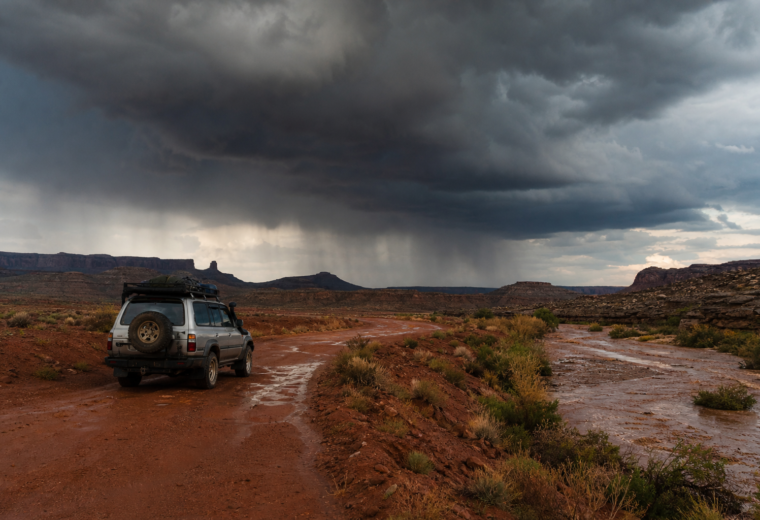
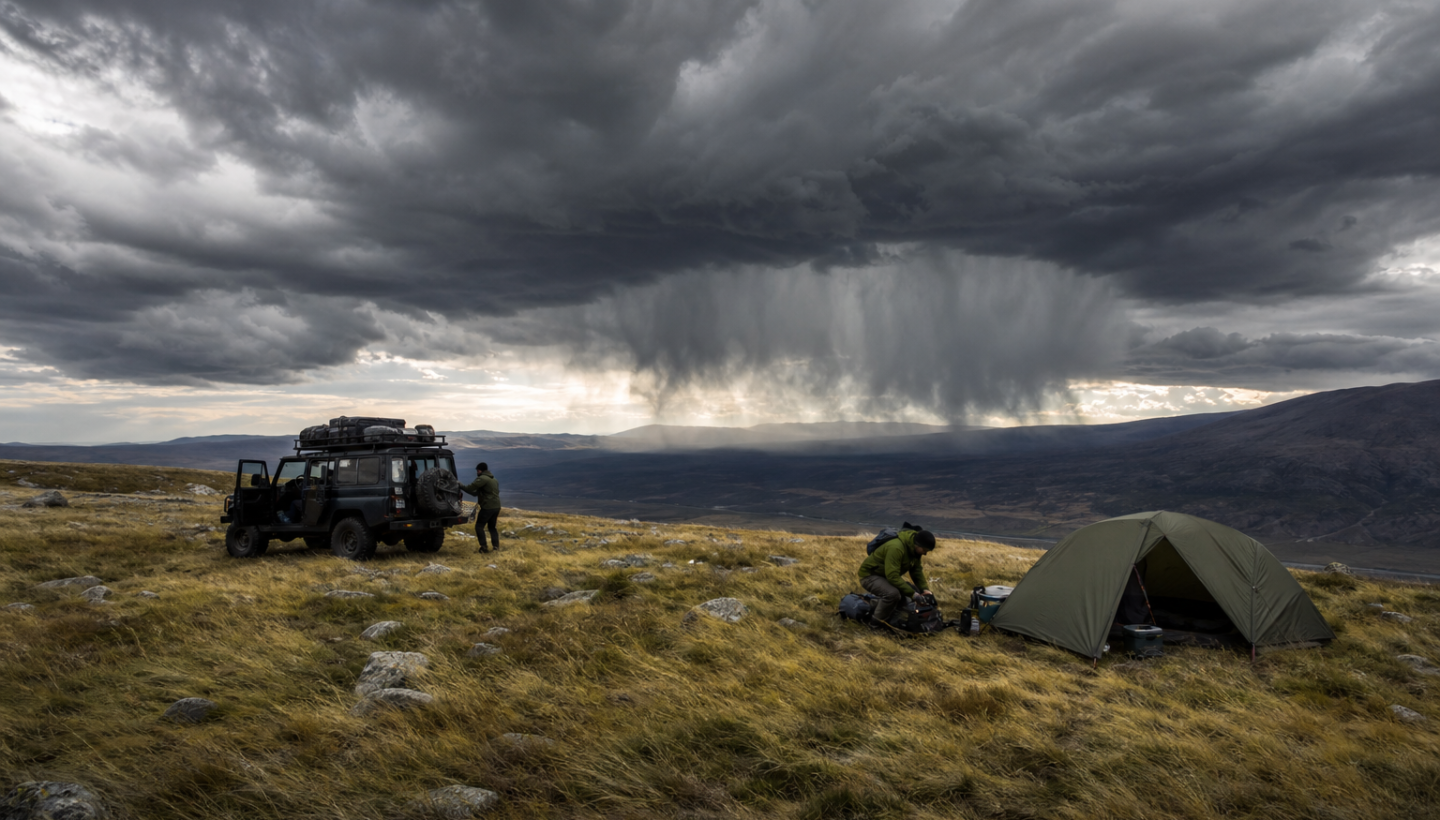
Virga looks like streaks or curtains hanging below a cloud, often fading before they touch the ground. Many campers dismiss it because they stay dry. That is a mistake, especially in dry country, high desert, and mountain basins.
Virga often signals that precipitation is evaporating into dry air below the storm. That evaporation cools the air rapidly, and the cooled air can plunge downward and spread out as strong, sudden winds. In practical terms, a storm can throw a hard gust front at camp even when the rain core is still distant or never arrives directly overhead.
If you see virga nearby, think less about getting wet and more about getting hit by dust, falling branches, flying gear, and abrupt temperature change. Secure tarps and awnings early, close rooftop tents if needed, and avoid exposed spots where a microburst-style outflow could create chaos fast.
Wind shifts, sudden gust fronts, or an eerie calm
Wind is often the first part of a storm to reach camp. A noticeable directional shift, a burst of cool gusts coming from a new quarter, or a line of advancing dust can all indicate that storm outflow is arriving. In open country, you may be able to watch it move across the landscape before it hits.
Equally important is a sudden unnatural calm after a breezy afternoon. While calm conditions do not always mean a storm is imminent, a sharp drop in wind followed by darkening clouds can indicate a transition in local pressure and air movement. It is one of those subtle signals that matters more when paired with others.
Wind changes deserve immediate attention because they affect the safety of camp setup itself. Shelters that were stable an hour ago may become liabilities. A kitchen under a loose canopy, a vehicle parked under a widowmaker branch, or gear spread across camp can become a problem before rain even starts.
A fast temperature drop
Campers often notice this one physically before they think about what it means. A sudden cool push of air on a hot afternoon is commonly associated with storm outflow. It can arrive well ahead of the rain shaft and often marks the point where the weather is no longer just “building” but actively affecting your location.
Temperature drops matter because they tend to confirm that the atmosphere is changing in a way you can feel, not just observe. When paired with growing clouds and changing wind, that cool air is a strong cue to compress decision time. Move now, not after dinner, not after “one more look,” and not after the first flash.
Distant thunder is not distant enough
If you can hear thunder, the storm deserves respect. Sound can carry a long way in clear air, across open basins, and through mountain country. Many people make the mistake of treating thunder as background noise until the storm is visibly overhead. That delay is especially dangerous above treeline, on ridges, near lakes, and in broad open terrain.
Lightning can strike well away from the rain core. For a remote camper, that means you may still have blue sky overhead while already being inside the storm’s hazard zone. If thunder is increasing in frequency or becoming more distinct, start de-exposing yourself: leave summits, avoid isolated trees, step away from water edges, and stop acting as though the first raindrop is the starting signal.
How terrain changes what the sky is telling you
The same storm behaves differently depending on where you camp. Reading the sky well means translating weather signs through the terrain around you.
Mountains and ridgelines
Mountains generate and intensify convection, especially in summer. Clouds often build first over peaks and then drift or spread outward. A storm that looks “over there” can move into your basin faster than expected, and ridgelines dramatically increase lightning exposure. If you are camped high, visual weather cues should prompt earlier retreat than they would on lower ground.
Washes, canyons, and desert drainages
In arid terrain, the storm does not have to be overhead to create danger. Rain falling miles away can funnel into normally dry washes and slot-like drainages. If you see strong build-up over upstream terrain, or if thunder and virga are concentrated beyond your immediate horizon, your campsite may still be in the path of runoff. Remote campers get into trouble by focusing only on the sky directly above camp instead of the drainage feeding it.
Forested camps
Tree cover can make storms feel less exposed, but it introduces branch-fall and snag hazards. Gust fronts and outflow winds matter more here than they do on open gravel pads. A forest camp that seemed sheltered in calm weather can become one of the worse places to wait out strengthening winds.
Open flats and playa-style terrain
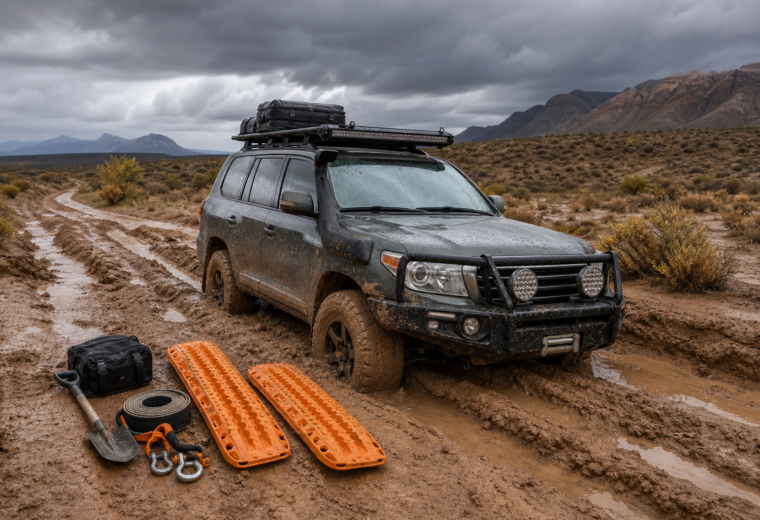
In broad open country, you may have excellent visibility but poor shelter. Storm movement is easier to read, but wind can arrive with little friction to slow it. If roads are clay-based or shallowly rutted, your retreat window may close quickly once rain begins. In these areas, early departure is often smarter than trying to ride out a cell and leave afterward.
Make camp decisions before the storm forces them
The biggest mistake remote campers make is waiting for certainty. Weather decisions rarely come with certainty; they come with enough evidence to act prudently. When multiple signs line up, use a fast decision framework:
- Look up: Are clouds growing vertically, darkening underneath, or spreading into a more organized shape?
- Look out: Can you see virga, dust plumes, advancing curtains of rain, or active build-up over terrain that drains toward you?
- Feel the air: Has the wind shifted or strengthened? Did the temperature drop suddenly?
- Listen: Is thunder audible, becoming clearer, or more frequent?
- Reassess the camp: Are you exposed to lightning, flooding, falling branches, or a road that will worsen quickly?
If the answer to several of those is yes, move from observation to action. In practice, that usually means:
- Stowing loose gear before gusts arrive.
- Lowering or removing awnings and nonessential shelter fabric.
- Repositioning away from washes, narrow drainages, and isolated tall trees.
- Leaving ridges, summits, and shorelines early.
- Pointing the vehicle for a clean exit instead of a complicated turnaround.
- Retreating while roads are still manageable, not after they become slick, flooded, or obscured.
One of the most valuable habits in remote travel is making least-regret decisions. Packing up 30 minutes early is usually an inconvenience. Packing up 30 minutes late can become a recovery, medical, or overnight survival problem.
Key Takeaways
- Watch for trends, not single signs. The most reliable warning comes when cloud growth, wind change, cooling air, and thunder start aligning.
- Virga is not harmless. Rain that evaporates before reaching the ground can still produce strong outflow winds and dangerous camp conditions.
- Distant thunder means you are already in the decision zone. Do not wait for rain overhead before reducing lightning exposure.
- Terrain changes risk. Mountains increase lightning and storm development, while washes and drainages can flood from storms that never pass directly over camp.
- Early retreat is often the smartest move. Remote weather problems become much harder once wind hits, visibility drops, and exit routes deteriorate.
Related Resources
- https://www.weather.gov/safety/lightning — The National Weather Service’s lightning safety guidance is a strong refresher on how far lightning can reach and when to seek safer shelter.
- https://www.weather.gov/safety/flood — Official flood and flash flood safety information, especially useful for understanding why dry washes and low crossings become dangerous so quickly.
- https://www.weather.gov/jetstream/clouds — NOAA’s JetStream cloud guide helps campers identify cloud types and understand which ones signal developing instability.
- https://scied.ucar.edu/learning-zone/clouds — UCAR’s cloud learning resources provide clear visual explanations of cloud development and the atmospheric processes behind storm growth.