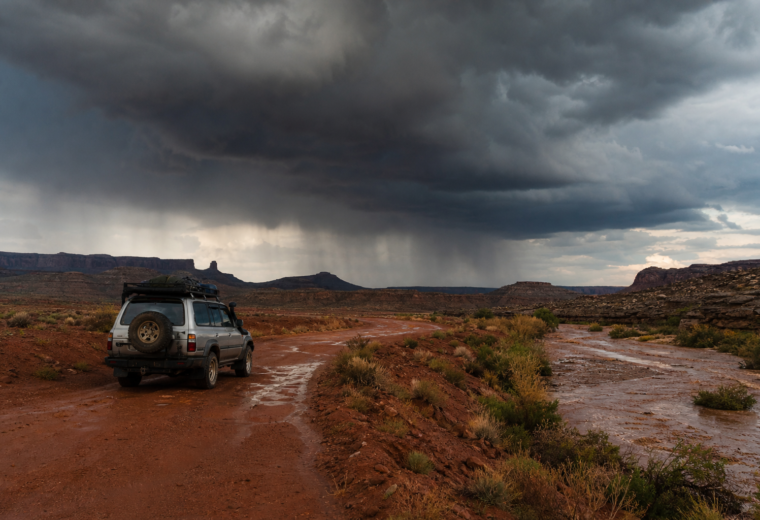
Monsoon-season mud has a talent for making ordinary recovery mistakes expensive fast. In dry country, a track that carried you yesterday can turn into a slick, crusted trap after one storm, and the wrong response usually makes the vehicle harder to recover, not easier. The pattern is predictable: too much throttle, a bad exit line, an improvised anchor, the wrong strap, and no real traction plan. If you travel wet desert roads, clay flats, or storm-soaked two-track, the safest recovery starts by understanding why monsoon mud punishes impatience.
Why Monsoon Mud Is Different
Wet desert mud is often worse than it looks. A thin dry skin can hide slurry underneath, while fine silt and clay pack into tire tread and turn an all-terrain tire into a smooth drum. In washes and low spots, runoff undercuts the surface, so what looks firm may collapse under load. On caliche roads, the top can be slick enough that the vehicle slides before it digs, which creates a false sense of progress right before traction disappears.
The important point is simple: not all mud failures come from lack of horsepower. Many come from a surface that loses shear strength the moment you spin, steer sharply, or load it sideways. That is why aggressive inputs usually make the problem worse.
- Clay-heavy mud sticks to tires and fills tread voids.
- Silty mud liquefies easily and can swallow a tire quickly.
- Crusted desert surfaces may look drivable until they break under one wheel.
- Runoff channels and road edges are often softer than the main track, even when they look cleaner.
Mistake 1: Spinning Until the Vehicle Sits on the Frame
The most common recovery error is also the fastest way to turn a minor bog into a major extraction: staying in the throttle after momentum is gone. The first few seconds of wheelspin shear the surface. The next few seconds dig holes, polish the mud, and pack the tread. After that, the axles, differentials, or skid plates begin resting on the mud, and now the vehicle is not just traction-limited, it is belly-hung.
This is why a vehicle can feel like it is “almost moving” while actually getting worse every second. Traction control, lockers, and four-wheel drive can help, but they cannot overcome a chassis that is dragging or tires that have become slick mud rollers.
If you need more throttle every second, the recovery is already getting worse.
Safer practice
- Stop early. The moment forward motion drops off sharply, lift out of the throttle.
- Get out and inspect. Check tire depth in the ruts, belly clearance, and whether one side has sunk more than the other.
- Clear mud where it matters. Dig in front of the tires, under the differential housings, and under any crossmember that is dragging.
- Air down deliberately. A larger footprint often helps more than added power, but stay within the limits of your tire, wheel, load, and recovery experience.
- Use gentle input. Low range, a higher gear where appropriate, and smooth throttle typically work better than sudden bursts.
Mistake 2: Choosing the Shortest Line Instead of the Best Line
When a vehicle gets stuck, people naturally want the nearest exit. In monsoon mud, the shortest path is often the worst one. Drivers cut toward the shoulder, aim for a dry-looking edge, or try to yank the vehicle sideways out of a rut. That creates extra drag, risks sliding into softer ground, and introduces side loads that neither the vehicle nor the recovery gear likes.
Very often, the best line is simply the way you came in. The ground behind you has already supported the vehicle once. It may not be perfect, but it is known. By contrast, the untouched edge of a road may be softer, undercut, or hiding vegetation and holes that trap a tire immediately.
What a better recovery line looks like
- It stays on the most compacted, most proven surface available.
- It avoids sharp steering angles during the pull.
- It minimizes crossing deep ruts at an angle.
- It gives the recovery vehicle room to remain on firmer ground.
- It avoids low spots, runoff channels, and polished road crowns.
A good rule is to separate distance from difficulty. A longer reverse path on firm ground is usually easier and safer than a short diagonal pull across soft mud.
Mistake 3: Bad Anchor Decisions in Soft Ground
Wet desert travel adds a problem many wooded trails do not have: there may be no solid natural anchor at all. That leads people to improvise. They hook to a small shrub, a questionable tie-down loop, another vehicle that is not really on firm ground, or worst of all, a trailer hitch ball. In mud, this is where a frustrating recovery becomes a dangerous one.
An anchor is only as reliable as the ground beneath it. A second vehicle parked in saturated soil may slide instead of hold. A bush or small tree in wet ground can uproot far more easily than expected. And diagonal pulls from poor anchor locations increase both load and instability.
Safer anchor choices
- Use only rated recovery points. Factory shipping loops, tie-down points, and random brackets are not recovery points.
- Prefer a receiver-mounted recovery point or manufacturer-rated front and rear recovery points.
- Use a properly staged second vehicle only if it is on verified firm ground, aligned sensibly, and controlled with brakes or chocks as needed.
- Carry a purpose-built ground anchor if you regularly travel solo in treeless terrain and already know how to use it.
- Do not trust a marginal anchor just because a winch is slow. A poorly rigged winch recovery can still fail violently.
A double-line winch pull can improve control and reduce demand on the winch, but it does not magically turn a weak anchor into a safe one. If you cannot identify a trustworthy anchor, the smartest decision may be to stop escalating and call for help before the situation degrades further.
Mistake 4: Treating Every Strap Like the Same Tool
One of the most overlooked problems in recovery is tool confusion. People use the word “tow strap” for everything, but recovery gear is not interchangeable. A static tow strap, a kinetic rope, a tree saver, a winch extension, and a bridle do different jobs. In mud, where resistance changes suddenly and suction loads can be high, using the wrong one adds shock to the system at exactly the wrong moment.
A kinetic rope is designed to stretch and deliver energy progressively in a controlled vehicle-to-vehicle recovery. A winch extension is not. A tree saver is meant to protect an anchor and spread load, not substitute for a snatch strap. And no strap becomes safer because it was “only a short pull.”
Basic rules that prevent injuries
- Match the tool to the recovery method. Use kinetic gear only when both vehicles have rated points, adequate space, and operators who understand the technique.
- Inspect every component. Mud hides cuts, abrasion, crushed fibers, damaged stitching, and bent hardware.
- Use rated connectors. Recovery-rated bow shackles or appropriately rated soft shackles are not optional details.
- Keep people well clear. No one should stand in line with tensioned gear or step over a loaded line.
- Never use a hitch ball as a recovery point. Use a proper receiver recovery insert instead.
- Avoid knots in straps or winch lines. Knots change load behavior and can severely weaken the system.
Line dampers and heavy recovery blankets can be useful, but they do not compensate for poor rigging. Distance, correct hardware, and calm, deliberate technique matter more.
Mistake 5: Starting the Pull Before Building Traction
Many recoveries fail because the driver reaches for the strap before doing the quiet work that actually reduces resistance. Mud recovery is rarely just about pulling harder. It is about lowering the amount of force needed to move the vehicle in the first place.
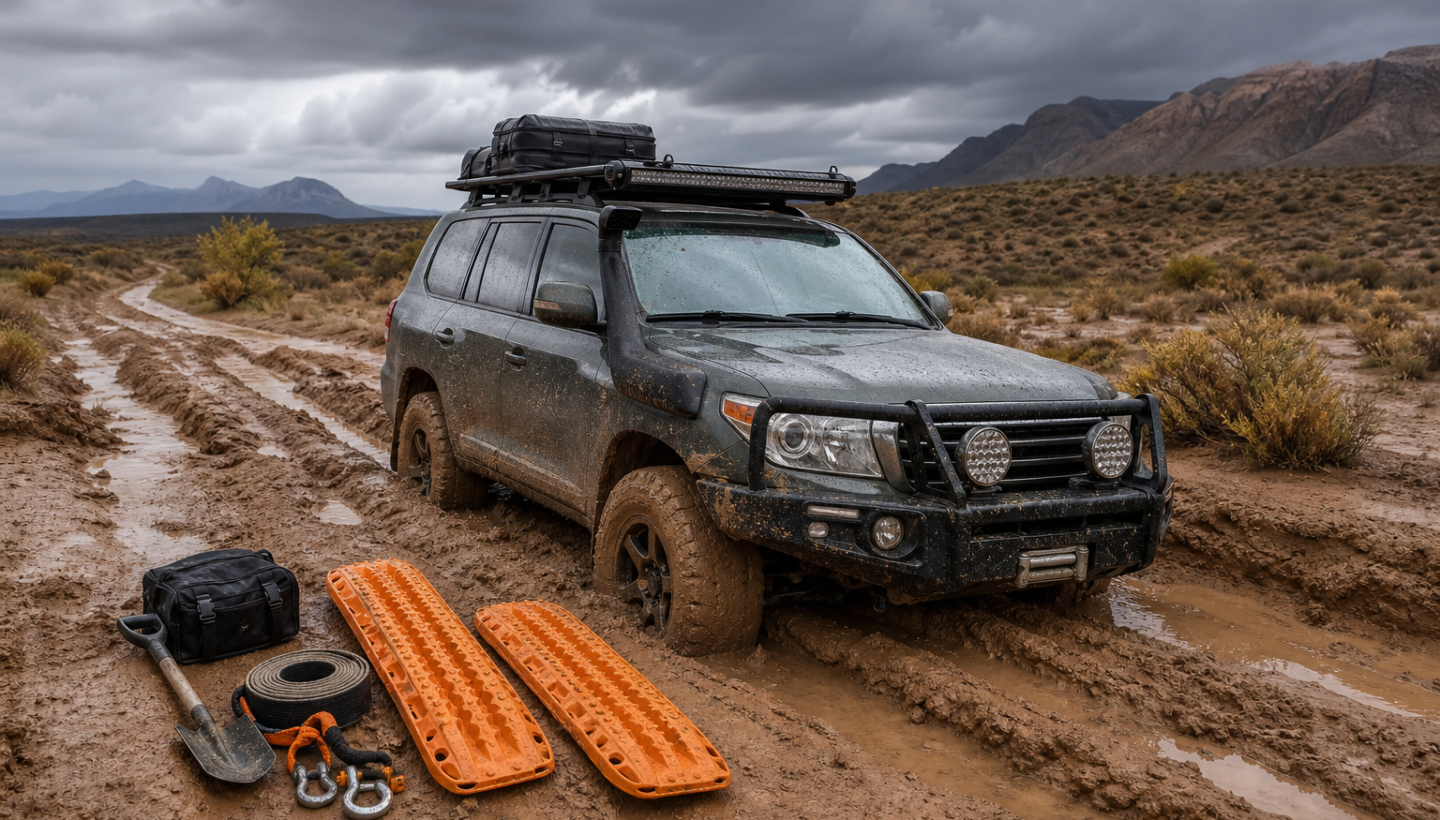
That means creating a path, not just adding load. A vehicle that needs a violent yank when buried to the axles may only need a controlled pull after ten minutes with a shovel, lower tire pressure, straighter wheels, and traction boards placed correctly.
Build traction before you pull
- Shovel under the chassis so the vehicle is not dragging mud with every attempt.
- Straighten the front wheels unless a slight steering angle is part of a planned exit line.
- Clear packed tread if the tires are completely slicked over with clay.
- Place traction boards under the tire contact patch, not several feet ahead where the tire must spin to reach them.
- Use sand, brush, or coarse material under boards if needed so they do not skate on slurry.
- Reduce load on the recovery system before you ask the gear to do all the work.
If your vehicle has selectable drive modes, lockers, or traction-control settings, know how they behave in mud before you need them. Some systems help with smooth progress; others react in ways that cut momentum at the wrong time.
A Safer Recovery Sequence for Wet Desert Travel
In practice, the safest mud recovery usually follows a simple order. It is not dramatic, but it works.
- Stop the moment progress stalls. Preserve the ground you still have.
- Check the bigger picture. Watch the weather, nearby runoff, and whether the route could worsen quickly if more rain arrives.
- Lower resistance first. Dig, air down appropriately, and prepare traction aids.
- Choose the lowest-risk line. Usually that means a straight, known path back to firmer ground.
- Rig only with rated gear and rated points. If something feels improvised, it probably is.
- Use smooth, controlled inputs. Avoid jerky throttle and repeated failed attempts.
- Reassess after each attempt. If the vehicle is getting deeper, stop changing variables at random.
Recovery is not a test of commitment. In monsoon mud, restraint is often the skill that saves the most time, gear, and bodywork.
Recovery Kit That Actually Helps in Monsoon Mud
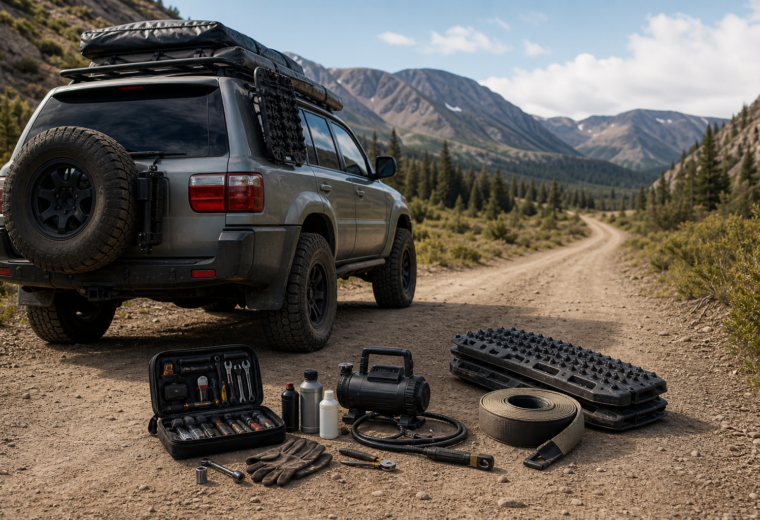
A useful mud-recovery kit does not need to be huge, but it does need to be coherent. Buy for function, not just for the look of preparedness.
- A long-handled shovel: still the highest-value tool for reducing drag and building a path.
- A quality tire deflator, gauge, and air compressor: traction starts with contact patch management.
- Traction boards: especially effective when the vehicle is only moderately buried and the path is prepared.
- Rated recovery points front and rear: without these, the rest of the kit is compromised.
- A properly sized kinetic rope or recovery strap: chosen for your vehicle class and used for its intended purpose.
- Winch extension, tree saver, or bridle as appropriate: support tools that expand safe rigging options.
- Rated shackles or soft shackles: sized to your system, not random leftovers from the garage.
- Gloves and a kneeling mat or tarp: small comfort items that matter when working in wet grit.
If you travel solo in remote, treeless country, a winch and a purpose-built ground anchor may be worth the weight, but only if you will train with them before the trip. For many travelers, a better first investment is simpler: tire management, traction boards, a shovel, and properly rated attachment points.
Key Takeaways
- Wheelspin is the fastest way to turn a minor stuck into a major recovery.
- The best escape line is often the route you already know, not the nearest shoulder.
- Anchors get weaker when the ground gets softer, so improvisation becomes more dangerous in monsoon mud.
- Recovery straps, kinetic ropes, winch extensions, and anchor slings are not interchangeable.
- Digging, airing down appropriately, and placing traction aids well can reduce recovery force more than brute pulling.
- Calm, rated, methodical recoveries beat hurried, high-energy recoveries almost every time.
Related Resources
- National Weather Service: Flood Safety — Official guidance on flash-flood hazards, which is essential when monsoon travel routes cross washes, low spots, or desert drainage.
- Ready.gov: Car Emergency Preparedness — A practical checklist for vehicle emergency supplies that pairs well with a dedicated off-road recovery kit.
- NHTSA Tire Safety — Reliable tire information on pressure, condition, and maintenance, all of which directly affect traction and safe airing down.
- Tread Lightly! — Useful principles for responsible motorized travel and minimizing trail damage when roads are saturated or fragile.