Dry camping is where your water system stops being a convenience and becomes a mission-critical part of the trip. In the desert, a small mistake in planning can turn a comfortable camp into a dangerous situation fast. There may be no creek around the next bend, no reliable spigot at the trailhead, and no guarantee that a mapped water point still exists. A good water strategy is built before you leave pavement: realistic consumption numbers, redundant storage, disciplined use, and a reserve you do not touch unless the plan has already failed.
Start With a Real Water Budget
The most common mistake is estimating water based on what you drink at home. Desert travel changes the math. Heat, wind, elevation, exertion, salty food, alcohol, pets, cooking, cleanup, and vehicle problems all increase demand. Build your water budget by category, not by guesswork.
Drinking Water for People
For mild conditions and low activity, many travelers use about 1 gallon per person per day as a baseline for drinking and basic cooking. In hot desert conditions, that number can become too low quickly. For strenuous hiking, recovery work, sand driving, or exposed camps, plan closer to 1.5 to 2 gallons per person per day for drinking and food preparation.
A practical field rule: if the forecast is above 90°F, if you will be active outside the vehicle, or if shade is limited, do not plan on the low end. Your body will use water even when you are sitting still in dry heat.
Pets
Dogs often need more water than owners expect, especially on hot ground. A medium to large dog may need 0.5 to 1 gallon per day, and more if hiking, running, or panting heavily. Carry a dedicated pet bottle or small jug so you can track their use separately. Hot sand and rock also increase heat stress through the paws, so pet hydration is part of heat management, not just comfort.
Cooking and Cleanup
Simple meals save water. Dehydrated meals, rice, pasta, and coffee all use water, and cleanup can use even more if you cook greasy food. Plan at least 0.25 to 0.5 gallon per person per day for cooking and dishes unless your menu is designed around low-water cleanup.
Use paper towels, a scraper, sand where appropriate, and a tiny amount of biodegradable soap before rinsing. Do not assume you will have enough water for a full sink-style dishwashing routine.
Hygiene
Hygiene water is flexible, but it still needs a number. Handwashing, brushing teeth, contact lenses, quick cloth baths, and medical cleanup all matter. Plan 0.25 to 0.5 gallon per person per day for minimal hygiene. If you expect showers, add several gallons per shower, even with a low-flow sprayer.
Do not eliminate hygiene water completely. Dirty hands cause stomach problems, and stomach problems in the desert create a much bigger water problem.
Vehicle and Camp Use
Water may be needed for radiator emergencies, cleaning dust from solar panels, rinsing wounds, cooling a person or pet, or handling a minor fire. You should not depend on drinking water for vehicle use, but you should plan for the possibility. A separate 1 to 2 gallon utility reserve is cheap insurance.
Calculate Trip Duration Plus a Safety Margin
Once you have daily water demand, multiply by the number of days between reliable resupply points. Then add a safety margin. Desert travel requires planning for delays: a washed-out track, a mechanical problem, a navigation mistake, high winds, or a campsite you cannot reach before dark.
A solid formula looks like this:
Total water = daily water need x planned days + emergency reserve
For example, two adults and one dog on a three-day desert trip might budget:
- People: 2 people x 1.5 gallons x 3 days = 9 gallons
- Dog: 0.75 gallon x 3 days = 2.25 gallons
- Cooking and cleanup: 1 gallon per day x 3 days = 3 gallons
- Hygiene: 0.5 gallon per day x 3 days = 1.5 gallons
- Utility water: 2 gallons
- Emergency reserve: 1 extra day of core drinking water = 3 to 4 gallons
That trip should leave with roughly 20 to 22 gallons, not 10. This may sound excessive until you are broken down on hot ground with no shade and no cell signal.
Build Redundancy Into Your Storage
One large tank is convenient. It is not a complete strategy. Tanks crack, fittings leak, pumps fail, valves get left open, and containers can be contaminated. In remote country, water redundancy is as important as tire redundancy.
Jerry Cans
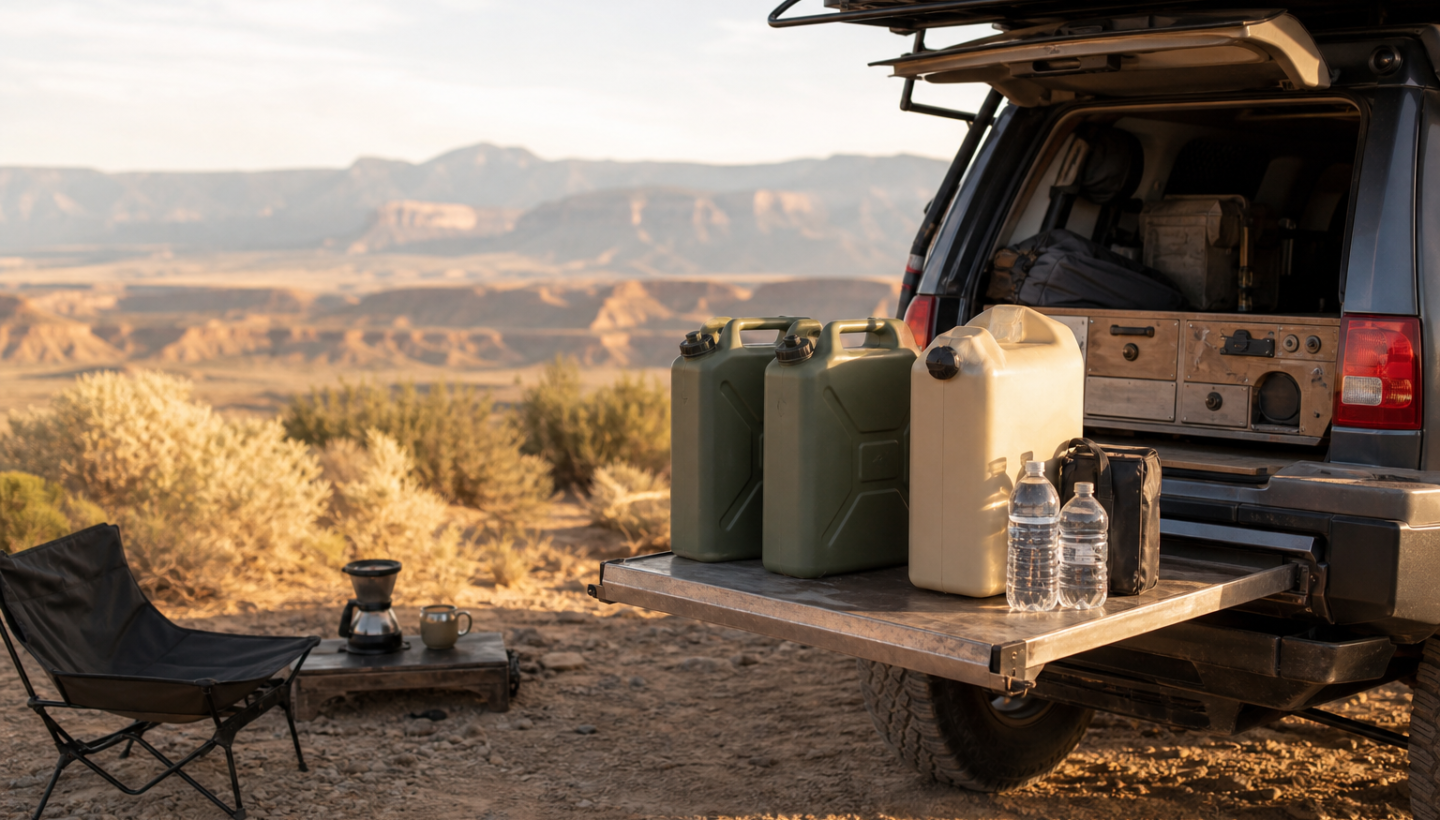
Hard-sided jerry cans are one of the most reliable options for overlanders and dry campers. They are durable, portable, easy to ration, and simple to move between vehicles or camps. A 5-gallon can is heavy but manageable for most adults. Two or three smaller cans also make it easier to isolate a leak or contamination problem.
Use food-grade water cans, not fuel cans repurposed for water. Label them clearly, keep caps clean, and store them where they will not rub through on metal edges.
Hard Tanks
Built-in tanks are excellent for vans, trailers, and truck campers. They keep weight low and organized, integrate with sinks or showers, and can hold large volumes. Their weakness is system complexity. A cracked fitting, frozen line, failed pump, or dirty fill hose can compromise the whole setup.
If you use a hard tank, still carry separate backup water in portable containers. Treat the tank as your main supply, not your only supply.
Water Bladders
Bladders are useful when space is irregular or when you need temporary capacity. They fit in footwells, truck beds, cargo areas, and roof boxes if properly protected. The tradeoff is vulnerability. Abrasion, punctures, and pressure damage are real risks.
Use bladders inside a protective tub, crate, or fabric sleeve. Avoid placing them near sharp recovery gear, tools, stove boxes, or hot surfaces.
Small Backup Bottles
Small bottles are underrated. Keep sealed bottles in several places: door pockets, daypacks, recovery bags, pet kits, and the rear cargo area. If you roll an ankle away from camp, separate from the vehicle, or lose access to the main tank, those bottles matter.
A smart setup spreads water across at least three layers: main supply, secondary portable supply, and personal emergency supply.
Plan Caches and Resupply Like Fuel Stops
In arid regions, water resupply should be planned with the same seriousness as fuel. Mark reliable sources before departure: staffed campgrounds, visitor centers, ranger stations, public water fill points, grocery stores, gas stations, and towns. Call ahead when possible. Seasonal closures, broken pumps, and dry spigots are common.
If a route requires more water than you can safely carry, build a cache plan. A water cache must be legal, ethical, protected from animals, protected from sun, and clearly marked for your own recovery. Do not leave plastic jugs where they can degrade or become trash. Use durable containers and retrieve them.
When you reach a resupply point, top off even if you think you have enough. In remote travel, passing known water with half-full containers is usually poor discipline.
Use Less Water Without Becoming Reckless
Conservation starts with habits, not panic rationing. You should reduce waste early so your reserve stays intact.
- Pre-hydrate before departure: Start the trip hydrated instead of catching up later.
- Travel during cooler hours: Drive, hike, and set camp in the morning or evening when possible.
- Create shade fast: A tarp, awning, or reflective panel reduces sweat loss and heat stress.
- Cook low-water meals: Choose wraps, couscous, tortillas, canned proteins, and one-pot meals.
- Use spray bottles: A small sprayer can handle hand rinsing, cooling, and light cleanup with minimal waste.
- Control dish mess: Eat from cooking pots, wipe before washing, and avoid greasy meals in water-scarce camps.
- Measure daily use: Mark containers or track gallons so you know your burn rate before it becomes a problem.
Never use conservation as an excuse to underdrink in heat. The goal is to cut waste, not to gamble with dehydration.
Understand Filtration and Purification Limits
Water filters are valuable, but they are not a magic answer in desert country. Many arid routes have no surface water at all. Some sources are seasonal, stagnant, alkaline, contaminated by livestock, or loaded with sediment. A filter cannot help if there is nothing to filter.
Most backpacking filters remove protozoa and bacteria, but not viruses unless specifically rated. Chemical treatments can handle many biological risks but may require longer contact time in cold or dirty water. Boiling is effective for pathogens but uses fuel and does not remove chemicals, salts, heavy metals, or agricultural runoff.
In desert basins, water may be mineral-heavy or chemically questionable. If a source smells strongly of fuel, chemicals, sulfur, or dead animals, do not assume treatment makes it safe. Filtration is a backup tool. Your primary strategy is carrying enough known-safe water.
Hydration Risks in Heat
Dry heat hides sweat. You may not feel soaked, but you are still losing water and electrolytes. Wind and low humidity evaporate sweat quickly, which can make dehydration sneak up on you.
Watch for early warning signs:
- Headache or irritability
- Dark urine or no urine for several hours
- Dizziness when standing
- Muscle cramps
- Dry mouth and cracked lips
- Unusual fatigue or confusion
Heat exhaustion and heat stroke are emergencies. If someone becomes confused, stops sweating in severe heat, collapses, or has hot skin and altered behavior, stop travel, cool aggressively, create shade, and seek emergency help.
Electrolytes matter too. Drinking only plain water during heavy sweating can dilute sodium levels. Pack electrolyte tablets, oral rehydration salts, or salty foods, especially for long hikes, recovery work, or multi-day heat exposure.
Signs Your Water Plan Is Weak
A poor water strategy usually reveals itself before the trip starts. Look for these red flags:
- You cannot state your total gallons carried.
- All water is stored in one tank or one container.
- You have no reserve beyond the planned return time.
- Your route depends on an unverified spring, tank, or spigot.
- You plan to filter water in an area with no reliable surface water.
- You have not accounted for pets, cooking, hygiene, or delays.
- You are already rationing on day one.
- Your containers are old, sun-damaged, unlabeled, or hard to access.
If any of these apply, fix the plan before departure. Desert travel punishes optimism and rewards boring preparation.
Pre-Departure Water Checklist
- Calculate daily demand: Include people, pets, cooking, hygiene, and utility use.
- Add a safety margin: Carry at least one extra day of core drinking water when traveling remotely.
- Split storage: Use a main supply, secondary containers, and small personal backup bottles.
- Inspect containers: Check caps, gaskets, seams, valves, hoses, fittings, and mounting points.
- Sanitize if needed: Clean tanks and cans before long trips, especially after storage.
- Verify resupply: Confirm water points, operating hours, seasonal closures, and backup towns.
- Pack treatment tools: Bring a filter, purification tablets, or boiling capability, but do not rely on them as your only plan.
- Carry electrolytes: Include salts or oral rehydration options for high-heat exertion.
- Stage water accessibly: Do not bury all water under recovery gear or sleeping platforms.
- Track consumption: Know how much you use each day and adjust early.
Key Takeaways
- Plan by gallons, not guesses: Desert water demand is higher than normal daily use.
- Carry more than the itinerary requires: Delays, heat, and mechanical problems are part of remote travel.
- Redundancy is non-negotiable: Split water across tanks, cans, bladders, and personal bottles.
- Filters are backups, not a desert water plan: Many arid routes have no dependable source to treat.
- Conserve early, hydrate consistently: Save water through smart habits, not dangerous underdrinking.
Related Resources
- Ready.gov: Water — Practical emergency water storage and treatment guidance from the U.S. government.
- CDC: Making Water Safe in an Emergency — Clear guidance on boiling, disinfecting, and filtering water when normal supplies are compromised.
- National Park Service: Heat Illness — Field-relevant information on recognizing and responding to heat-related illness outdoors.
- World Health Organization: Drinking-water — Global public health context on drinking water safety and contamination risks.