Southwest summer travel exposes weak links fast: cabins turn into ovens, soft coolers become useless by noon, water plans fail quietly, and a casual thunderstorm can turn camp into a windblown mud problem in minutes. The best gear upgrades are not the flashiest ones; they are the ones that reduce exposure, preserve energy, and buy you time when a minor inconvenience starts cascading into a safety issue.
What Makes a Summer Travel Upgrade Worth the Money
For remote travel in Arizona, New Mexico, Utah, Nevada, West Texas, and the desert stretches between towns, a high-value upgrade usually does one of three things: lowers heat load, adds redundancy to essentials, or reduces setup and response time. That matters because in extreme heat, energy and decision-making degrade faster than most people expect.
If you are upgrading in stages, prioritize systems in this order:
- Water capacity and access
- Shade and ventilation
- Tire support and recovery basics
- Reliable communications
- Onboard power for cooling, charging, and lighting
- First aid and monsoon-specific camp readiness
In Southwest summer, the best gear is often the gear that lets you solve a problem in five minutes instead of surviving it for five hours.
Heat Management Upgrades That Actually Reduce Fatigue
Most people think of heat as a comfort issue. In practice, it is a performance issue. A hot vehicle, poor airflow, and warm drinking water can turn a manageable day into a slow, error-prone one.
Start with the vehicle interior
A quality windshield reflector, side-window shades, and a breathable seat cover are low-cost upgrades with outsized value. They reduce cabin soak while parked and make short stops less punishing. If your vehicle allows it, legal heat-rejecting window tint is another upgrade that pays back every single day.
The next step is airflow. A small 12V or rechargeable fan aimed at the driver at lunch stops or at sleepers in camp makes a bigger difference than many people expect, especially when paired with shade. Fans do not lower ambient temperature, but they improve evaporative cooling and help people keep drinking, eating, and resting normally.
Cold storage is a heat-management tool
A good 12V compressor fridge is not just a luxury food upgrade in summer. It protects medications, keeps electrolyte drinks usable, and removes the constant ice-hunting cycle that burns time and fuel in remote areas. For multi-day travel, it is one of the clearest quality-of-life improvements you can make. If your budget is limited, upgrade the water and shade system first, then move to a fridge once the basics are covered.
Water Storage: Build a System, Not Just Capacity
In the Southwest, water planning fails less often from total shortage than from poor access, contamination, or lack of backup. A single large container is better than nothing, but a layered water system is safer and easier to live with.
The most practical setup for most travelers
- Primary container: a rigid 3- to 7-gallon container with a spigot for cooking and camp use
- Secondary reserve: separate sealed bottles or a second can stored apart from the primary
- Personal carry: individual bottles or hydration bladders kept inside the cab where they are always reachable
- Treatment backup: a filter and a chemical purification option in case you must use marginal water
This matters because water loss in the field is rarely dramatic. A leaky spigot, a contaminated jug, or forgetting to refill the “main” container can quietly erase your plan. Separate containers create redundancy. They also let you ration intelligently: one for drinking, one for cooking, one untouched emergency reserve.
Look for containers with reliable caps, easy cleaning access, and shapes that secure well in a vehicle. Wide mouths are easier to sanitize. Opaque containers resist algae growth better than clear ones. If you use collapsible bladders, treat them as reserve storage rather than the only source; they save space, but rigid containers usually survive rough desert travel better.
Do not overlook electrolytes. Plain water is essential, but long, hot days with sweat loss call for a simple electrolyte plan. A small stash of oral rehydration packets or low-sugar electrolyte mixes belongs in the same category as water storage, not as an afterthought.
Shade Is One of the Highest-Value Camp Upgrades
Few upgrades improve desert camp life faster than dependable shade. It lowers interior temperatures, protects food prep, makes rest possible, and gives you a place to troubleshoot gear without baking in direct sun.
Awning or tarp?
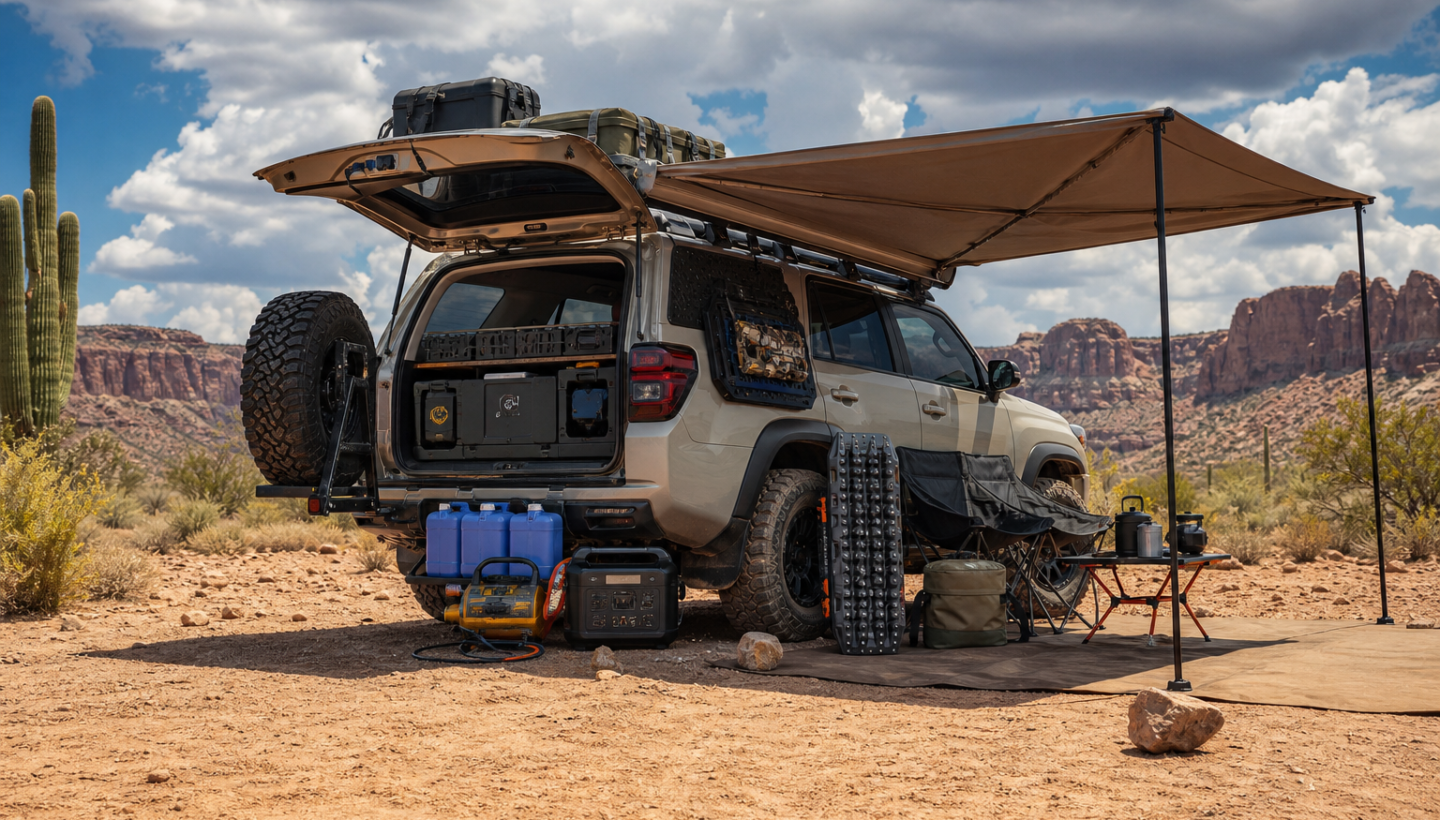
Vehicle awnings are fast and convenient, which matters when arriving tired in late heat. But for monsoon-prone summer travel, a reflective tarp or mesh shade system with poles, guylines, and proper anchors often offers better flexibility. You can place it where the shade is needed, lower it in wind, and avoid loading a vehicle-mounted awning in gusty conditions.
A strong setup usually includes:
- A reflective tarp or shade mesh such as aluminized knit shade cloth
- Adjustable poles
- Extra guylines
- Real stakes or screw-in anchors for hard ground and wind
- At least one repair method for torn grommets or fabric
The difference between “we have shade” and “we use shade” is deployment speed. If your shelter takes too long to set up, you will skip it when it matters most. Choose the system you can deploy quickly, even alone, in heat and wind.
Tire Support for Heat, Rock, and Distance
Hot pavement, sharp volcanic rock, washboard roads, and long stretches between services make tire support a core Southwest upgrade category. A more aggressive tire helps, but the real value comes from the support system around the tire.
What belongs in a serious tire kit
- A quality portable air compressor with enough duty cycle for all four tires
- An accurate tire gauge
- A plug kit with reamer, insertion tool, plugs, and a blade
- A full-size spare if your route takes you well beyond pavement
- A jack solution that works on uneven ground, plus a base plate
- Valve stems and core tool as cheap insurance
For many travelers, the biggest upgrade is not the tire itself but the ability to air down appropriately and air back up reliably. Lower pressure can improve ride quality and reduce puncture risk on rough roads, but only if you can reinflate with confidence before high-speed pavement. A portable compressor turns tire pressure from guesswork into an adjustable tool.
If you regularly travel rocky tracks, prioritize sidewall strength and load rating over purely marketing-driven tread patterns. Summer blowouts and cuts are expensive not just because of the tire, but because they compound heat exposure and time spent roadside.
Communications: Spend for Reach, Not Just Gadget Appeal
Cell service in the Southwest is inconsistent exactly where self-reliant travelers like to go. If you make one communications upgrade, make it a satellite messenger with two-way capability. It gives you emergency signaling, check-ins, and the ability to communicate a non-life-threatening problem before it becomes one.
For group travel, GMRS radios add real value for convoy movement, spotting, and camp coordination. They are not a replacement for satellite capability, but they are often more useful day to day than people assume.
Support the comms plan with redundancy
- Keep offline maps on your phone
- Carry a second navigation device or backup phone
- Store charging cables in more than one place
- Save key coordinates before leaving service
The strongest communications setup is simple: one device for long-range emergency contact, one for local coordination, and a navigation plan that does not depend on live signal.
Onboard Power for Fridges, Fans, and Daily Reliability
Once you add a fridge, fans, lighting, radios, and device charging, casual power management stops working. The question is not whether you need more power, but how integrated the system should be.
Best value for most readers
A LiFePO4 power station in the 500Wh to 1000Wh range is the easiest upgrade path for many vehicles. It can run a fridge, charge devices, support lighting, and move between vehicle and camp without permanent installation. Pair it with vehicle charging and use solar as a supplemental input rather than your only plan.
If you travel frequently, stay out longer, or want a cleaner permanent solution, a dual-battery system with DC-DC charging is the stronger long-term answer. It handles repeated cycling better, integrates with fridges and outlets more neatly, and reduces the clutter of portable workarounds.
Whichever route you choose, pay attention to heat. Batteries and electronics hate being baked in closed vehicles. Ventilate storage areas, keep power stations out of direct sun, and avoid charging gear in extreme interior temperatures when possible. In desert travel, thermal management applies to electronics too.
First Aid Should Match Heat and Distance
A generic first aid pouch is better than nothing, but Southwest summer travel calls for a kit built around heat illness, wound care, and delayed help.
Useful upgrades beyond the usual basics
- Oral rehydration salts or electrolyte packets
- A digital thermometer
- Trauma supplies such as a tourniquet and pressure bandage, with training to use them
- Blister treatment and foot care
- Saline or wound irrigation tools
- Tweezers and tools for thorns, splinters, and cactus spines
- Antihistamines and any personally required medications stored within temperature limits
The key is not to build a giant kit. It is to build a kit that reflects the actual failure modes of hot, remote travel: dehydration, exhaustion, cuts, punctures, sun exposure, and long waits for assistance. Just as important, inspect it before every trip. Expired meds, dead headlamps, and half-used bandage rolls are common avoidable failures.
Monsoon-Ready Vehicle and Camp Systems
Summer in the Southwest is not just about dry heat. Monsoon storms bring sudden wind, dust, lightning, and flash-flood risk. Gear that works beautifully in calm weather can become a liability fast.
Vehicle-side upgrades worth making
- Fresh wiper blades and washer fluid
- Recovery points you trust
- Traction boards or a shovel for mud and soft ground
- Dry storage bins or waterproof bags for electronics and bedding
- Weather awareness tools, including forecast checks before losing service
Dust and rain also reveal small maintenance issues: poor door seals, clogged drains, weak battery terminals, loose rooftop loads, and aging straps. A monsoon-ready vehicle is usually a well-maintained vehicle with fewer weak points.
Camp systems matter just as much
Choose camp with drainage in mind, not just the view. Avoid washes, low pockets, and broad sandy channels even if they are dry at sunset. Use stakes and guylines that can handle gusts, and assume anything loose will blow. Keep one fast “storm mode” plan: where the chairs go, how the tarp drops, what gets packed first, and which gear must stay dry.
Key Takeaways
- Upgrade systems in order of consequence: water, shade, tires, comms, power, then comfort extras.
- Redundancy beats single-point capacity: two water containers and backup navigation are better than one bigger version of either.
- Deployment speed matters: the gear you can set up quickly in heat or wind is the gear you will actually use.
- Summer reliability is thermal reliability: protect people, food, batteries, and medical supplies from sustained heat.
- Monsoon season changes the equation: wind anchoring, drainage, weather awareness, and waterproof storage deserve real attention.
Related Resources
- National Weather Service: Heat Safety — Practical guidance on recognizing heat illness, planning activity around temperature, and reducing exposure.
- National Weather Service: Flood Safety — Essential reading for flash-flood awareness during Southwest monsoon travel and route planning.
- Ready.gov: Extreme Heat — A concise preparedness checklist for heat emergencies, hydration, and travel safety.
- Ready.gov: Build A Kit — Useful baseline for assembling or auditing a vehicle-based emergency and first aid kit.
- AirNow — Official air quality and smoke information that can materially affect summer route choices and camp conditions.