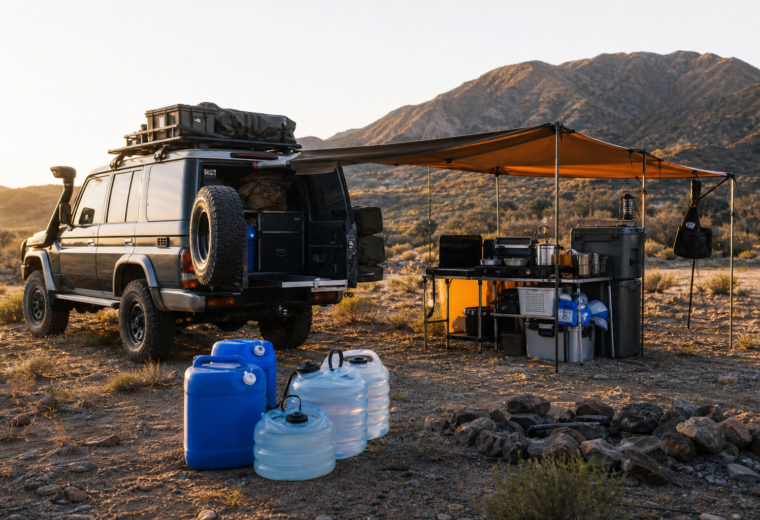
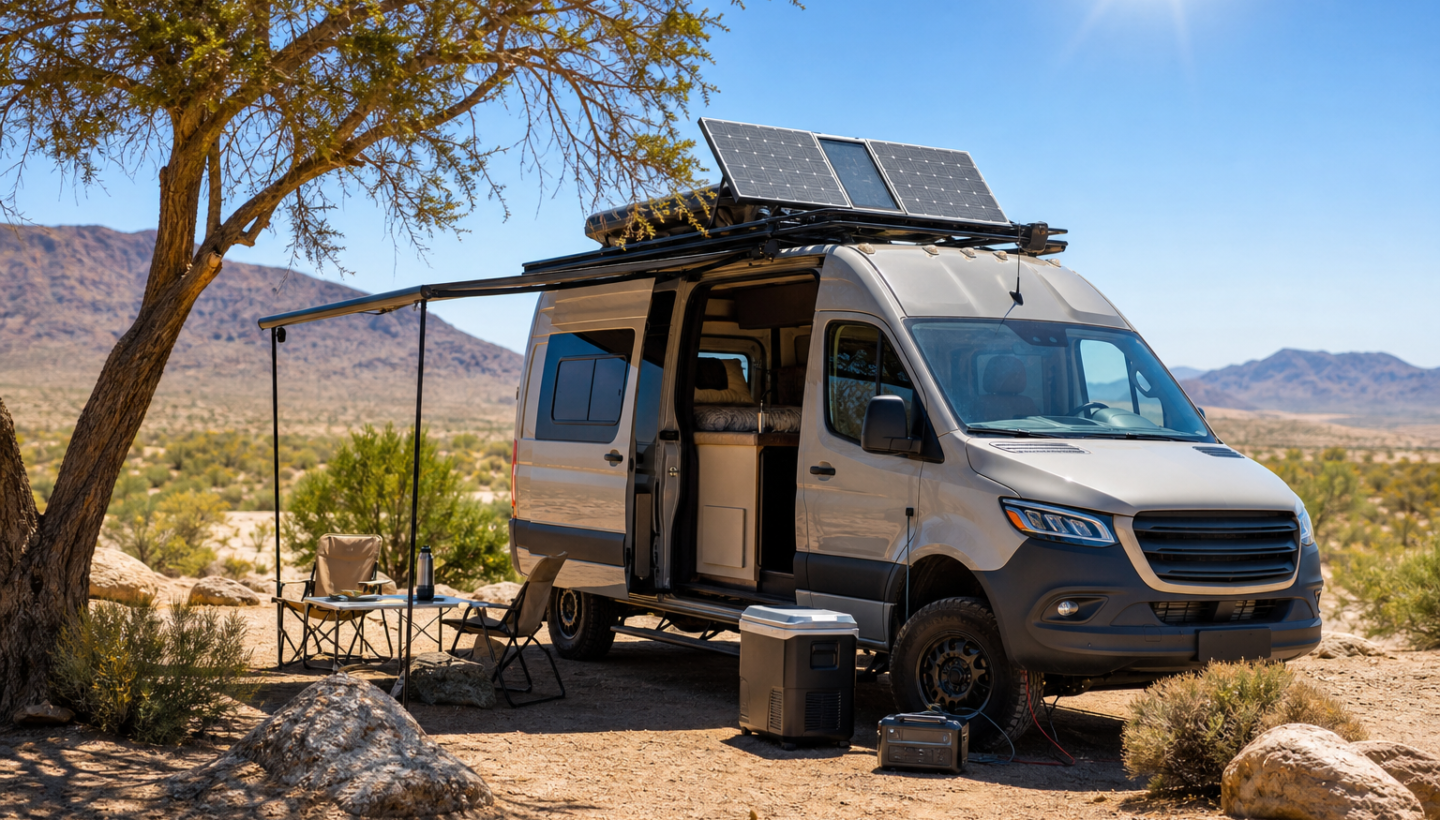
Hot weather can be just as punishing on an off-grid power setup as cold weather, and in some cases it is more dangerous because the system still appears to be working—just less efficiently, with less margin for error. Solar panels lose output as they heat up, batteries age faster when they spend their life in the sun, fridges run longer, and inverters turn every watt into a little more heat. If you travel in a van, overland rig, truck camper, or remote basecamp, summer is when a good power system proves itself.
The goal is not to make your camp power “bulletproof” in every scenario. It is to keep it stable, cool enough to operate safely, and sized with realistic expectations for peak summer conditions. A system that looks generous on paper can feel undersized on a 100-degree day when the fridge is cycling nonstop and the battery compartment is baking under a dark floor panel.
Why Heat Changes the Rules
Off-grid systems are built around assumptions, and heat breaks several of them at once. Batteries do not charge and discharge the same way at high temperatures. Solar panels produce less power when they get hot. Electronics such as charge controllers and inverters may reduce output or shut down to protect themselves. Meanwhile, your camp loads are usually higher because food spoils faster, you drink more cold water, and you may run more fans.
In other words, summer does not simply “use more power.” It reduces the amount of power you can make and increases the amount you need.
Batteries are the first place to pay attention
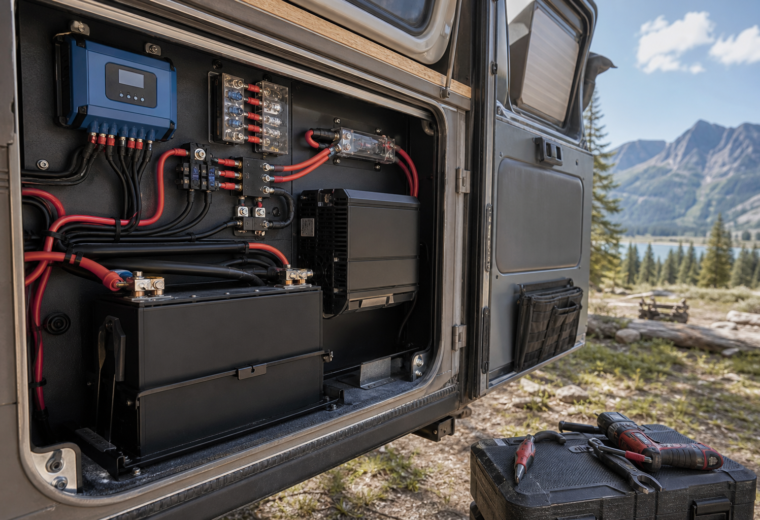
Battery chemistry matters. Many lithium iron phosphate systems are protected by a battery management system, but that does not mean they like extreme heat. A lot of lithium batteries will limit or stop charging when internal temperature climbs too high, often around 45°C / 113°F, though the exact cutoff depends on the manufacturer. Some can discharge hotter than they can charge, but long-term exposure to heat still shortens life.
Lead-acid batteries are more tolerant in one sense, but they are not summer-proof. Heat accelerates corrosion, water loss, and general wear. Flooded batteries need electrolyte checks. AGM batteries are sealed, but they still age faster when installed in a hot compartment. If your battery box or cabinet feels hot to the touch, treat that as a warning sign, not a normal condition.
Rule of thumb: if the battery compartment is uncomfortable to touch or the charging gear is repeatedly reaching thermal protection, your setup needs better ventilation, less charging stress, or a different mounting location.
Know Your Battery Temperature Limits
Every battery bank has an operating window, and summer travel can push you toward the top end of it. The most important habit is simple: read the manufacturer’s charging temperature limits. Do not assume your battery, charger, and solar controller all share the same threshold.
For lithium systems, especially LiFePO4, make sure the battery has:
- Low-voltage and high-temperature protection built into the BMS
- Temperature sensing for charging if recommended by the maker
- Clear installation space so heat can escape
For lead-acid systems, make sure your charger supports temperature compensation. A charger that uses the same voltage in cool mornings and hot afternoons is not ideal. Heat changes the correct charging voltage, and overcharging in summer can damage batteries more quickly than many travelers expect.
Also pay attention to where the batteries live. A battery bank mounted under a seat, inside a sealed cabinet, or over a hot wheel well can run significantly hotter than ambient air. Whenever possible, give batteries shade, airflow, and separation from heat sources such as inverters, compressors, and engine bay components.
Set Realistic Expectations for Solar Input
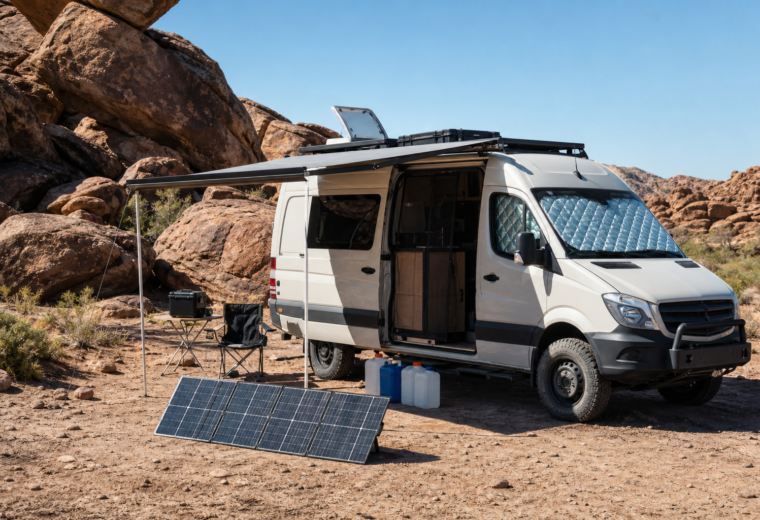
Solar is still the best long-range summer charging source for most mobile camps, but it is important to understand that solar panel ratings are measured under ideal test conditions that do not exist on a roof in July. Once the panel heats up in direct sun, output drops. Dust, smoke haze, angled mounting, roof racks, awnings, and rooftop gear can reduce performance even further.
That means a 400-watt array may not deliver 400 watts when you need it most. In summer, a real-world output of 70 to 85 percent of rating is often more realistic under good conditions, and lower numbers are normal when panels are dirty or partially shaded. Heat itself does not “kill” solar, but it quietly reduces the margin you thought you had.
Practical ways to improve solar performance
- Keep panels clean. A film of dust can matter more than many people expect.
- Avoid partial shade from roof boxes, traction boards, antennas, and awnings.
- Leave airflow beneath portable or tilting panels whenever possible.
- Check controller logs or battery monitor data instead of guessing at output.
- Do not assume peak sun hours equal peak power if the panels are very hot.
If you rely heavily on solar, it helps to think in terms of daily energy budget, not just panel wattage. Summer heat can shrink your surplus quickly, especially if you are also running a compressor fridge and fans.
Manage the Fridge Before It Manages You
For many overlanders and vanlifers, the fridge is the biggest continuous load in summer. Hot ambient temperatures make the compressor work harder, especially if the fridge sits in a poorly ventilated cabinet or receives direct sun through a window. Even a well-designed fridge can draw substantially more power on a hot afternoon than it does during a cool night.
The solution is not to panic over wattage. It is to make the fridge work less.
Summer fridge habits that save power
- Pre-chill before you leave. Start the trip with cold food, cold drinks, and a cold fridge, not a box full of warm groceries.
- Keep it shaded. Sun through glass or reflected heat from a hot floor can raise the load dramatically.
- Allow airflow. Compressor fridges need room around vents and cooling coils.
- Limit door openings. Every warm-air exchange costs energy.
- Use thermal mass. A few frozen water bottles can stabilize temperatures and reduce cycling.
- Set a sensible temperature. Do not run colder than you need for safe food storage.
If your fridge is your most important load, consider it a priority circuit. Protect it from heat, monitor consumption, and do not treat it like an afterthought attached to the side of your battery bank.
Use the Inverter Intelligently
Inverters are useful, but they are not free. Every time you convert battery power from DC to AC, you lose some energy as heat. In hot weather, that matters. The inverter itself generates heat, and large AC loads can push it into thermal derating long before your battery bank is actually empty.
Microwaves, coffee makers, induction cooktops, hair dryers, and large chargers are all heavy inverter loads. They may work fine for short periods, but they are the first things to stress a summer system. If you are already battling high ambient heat, a long inverter session can turn into a heat cascade: battery warms, inverter warms, wires warm, and voltage sag increases.
Whenever possible, use direct DC loads for fans, lighting, phone charging, and refrigeration. Reserve the inverter for short, necessary tasks. Keep it in a ventilated space, dust it out periodically, and make sure cables, terminals, and fuses are properly sized. A hot inverter is often a sign of poor placement, weak airflow, or excessive load—not just “normal operation.”
Build a Charging Strategy That Matches the Heat
In hot weather, charging strategy matters as much as charging source. The best summer systems do not depend on a single source all day long. They spread the work between solar, alternator charging, and, when needed, shore power or a generator. The trick is to charge smart, not just hard.
A practical summer charging rhythm
- Charge early when possible. Morning hours often offer cooler equipment and better battery health conditions, even if panel output is not at its peak.
- Use solar for the daily baseline. Let solar cover the fridge, fans, and light loads first.
- Top off before heat stress builds. If you know you will be parked in the afternoon sun, try to finish bulk charging earlier.
- Watch battery temperature, not just voltage. Voltage alone can hide a thermal problem.
- Do not force charge if the system is hot. Let the battery, charger, and inverter cool down if they are approaching protection limits.
For lithium systems, follow the manufacturer’s charge-temperature rules exactly. For lead-acid systems, make sure the charger uses temperature compensation. If your charger or battery monitor supports a remote temperature sensor, use it. That small sensor can prevent a lot of summer abuse.
If you are charging from an alternator or DC-to-DC charger, remember that the engine bay is already a hot environment. High-current charging while driving can be very effective, but it also adds thermal load to wiring and devices. Use proper cable sizing, solid grounding, and conservative charge profiles if your components are exposed to sustained summer heat.
Watch for Warning Signs Before Something Fails
Heat-related power problems usually give you clues before they become failures. Learn to recognize them early:
- Battery charge acceptance drops sharply even when the battery is not full
- Solar controller output is inconsistent despite clear sun
- Inverter fans run constantly or the inverter shuts down under modest load
- Fridge compressor runs nearly nonstop
- Cables, fuses, or terminals feel hotter than expected
- A battery monitor shows unusual current draw or voltage sag
If you see these signs, the answer is usually not to “push through.” Reduce the load, improve ventilation, and check whether the system is being asked to do more than it can safely handle in the current conditions.
Key Takeaways
- Heat reduces performance everywhere: batteries, solar panels, fridges, inverters, and wiring all feel summer stress.
- Battery temperature matters most: know your chemistry’s charge limits and do not ignore thermal protection events.
- Solar ratings are optimistic: hot panels produce less than their lab rating, especially when dirty or shaded.
- The fridge is usually the biggest summer load: shade it, ventilate it, and pre-cool before departure.
- Inverters should be used deliberately: they waste power as heat and can become a bottleneck in hot weather.
- Charge early and intelligently: combine sources, monitor temperatures, and avoid forcing charge into an already overheated system.
Related Resources
- Battery University: Charging at High and Low Temperatures — A practical overview of how temperature affects charging behavior and battery longevity.
- U.S. Department of Energy: How Do Solar Panels Work? — A clear, credible primer on solar fundamentals and why real-world output differs from ideal ratings.
- National Renewable Energy Laboratory: Photovoltaics Research — Useful background on solar performance, PV systems, and the science behind panel output.