
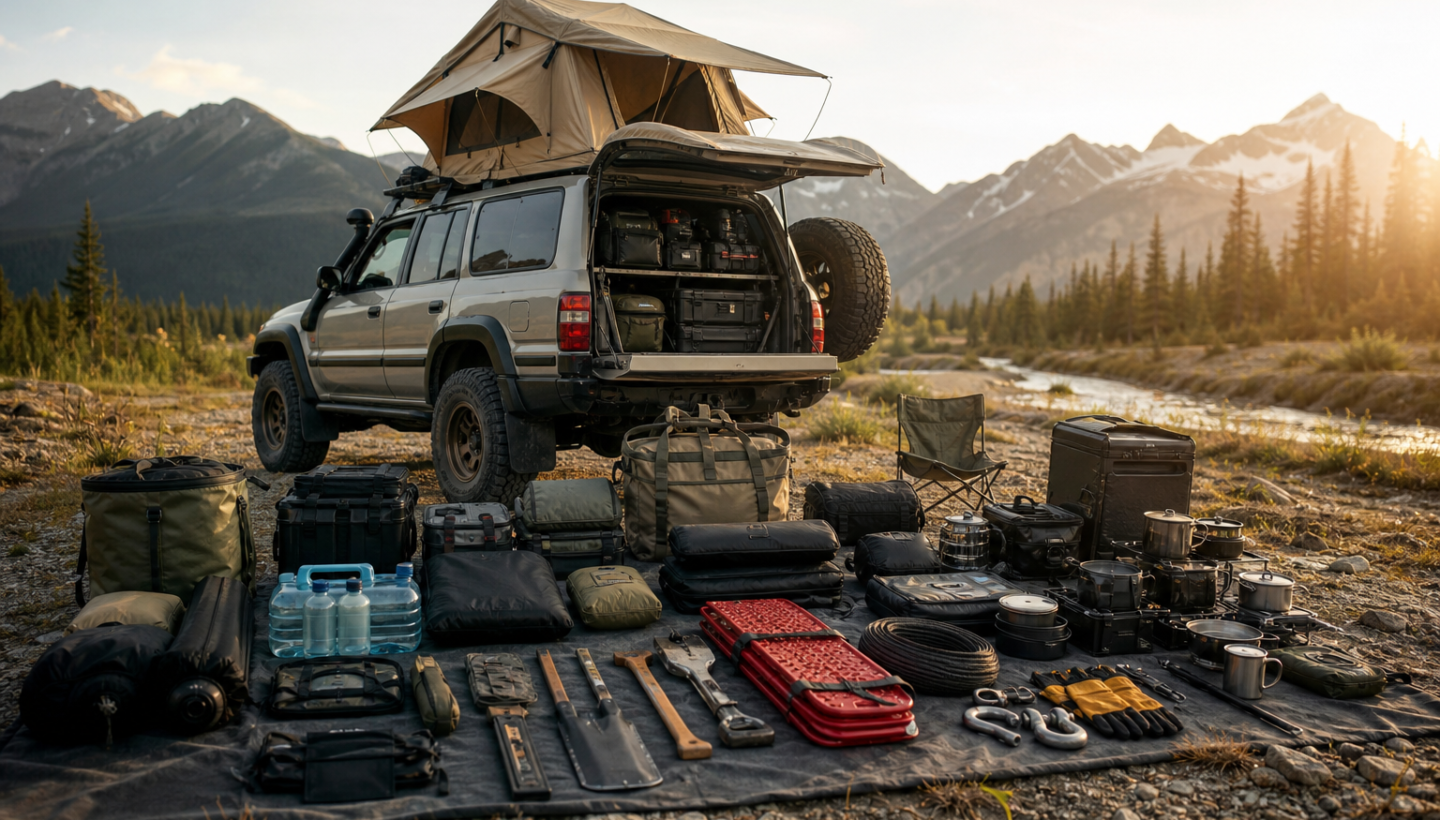
Every piece of remote travel gear sits inside a triangle: weight, durability, and packability. Push one corner too far and another corner usually suffers. A cast-iron skillet will outlive most vehicles, but it is heavy and awkward to store. An ultralight rain shell packs into a fist-sized pouch, but it may not survive years of brush, sparks, and daily abuse. A hard-sided water can is tough and dependable, but it eats space even when empty.
For remote travelers, overlanders, vanlifers, and off-grid campers, understanding this triangle is more useful than chasing “the best” gear. The right item is not the one with the most impressive spec sheet. It is the one that matches your vehicle, route, climate, repair ability, storage limits, and tolerance for failure. Good gear decisions come from knowing where to compromise before the trail makes the decision for you.
The Gear Triangle Explained
The three corners of the gear triangle are simple, but the tradeoffs are not always obvious.
- Weight: How much the item adds to your pack, drawer system, roof load, trailer, or vehicle payload.
- Durability: How well it survives impact, abrasion, weather, heat, vibration, misuse, and long-term field conditions.
- Packability: How efficiently it stores, nests, folds, compresses, or disappears when not in use.
No item excels at all three equally because materials and construction create limits. Thick materials are usually stronger but heavier. Rigid shapes protect contents but waste space. Thin fabrics compress well but can tear. Compact multi-tools save space but rarely perform as well as dedicated tools. The more honest you are about those limits, the better your kit becomes.
Field rule: Choose the corner that matters most for the consequence of failure. If failure creates discomfort, you can compromise. If failure creates danger, choose durability first.
How Priorities Change by Travel Style
A weekend camper, a long-distance overlander, and a full-time vanlifer should not evaluate gear the same way. The triangle shifts depending on how you move, where you sleep, and how quickly you can replace broken equipment.
Backpackers and Minimalist Remote Travelers
Weight dominates when every ounce rides on your back. Packability matters almost as much because volume limits food, insulation, and water capacity. Durability still matters, but it is usually targeted: reinforced stress points, repairable fabrics, and proven designs instead of bombproof construction everywhere.
For this group, the best gear is often lightweight but not fragile. A shelter floor may need a footprint in rocky terrain. A titanium pot may dent, but it will still boil water. A compact water filter is acceptable if you carry backup purification tablets.
Overlanders and 4×4 Travelers
Overlanders can carry more weight than backpackers, but payload is not unlimited. Heavy gear affects fuel economy, braking, suspension wear, tire stress, and center of gravity. Durability rises in priority because washboard roads, dust, vibration, and rough storage destroy flimsy equipment fast.
Packability is also critical in a vehicle because clutter slows everything down. If you have to unload half the cargo area to reach a jack base, your system is failing. Overlanding gear should be rugged, secure, and accessible.
Vanlifers and Full-Time Nomads
Vanlifers live with their gear every day. Packability often means livability. A bulky item that blocks a cabinet, rattles during driving, or requires constant rearranging becomes a daily irritation. Durability matters because full-time use turns “camping gear” into household infrastructure.
Weight still matters, especially with water, batteries, tools, recovery gear, and built-in storage. A van can quietly become overloaded because weight is added one drawer, one jug, and one upgrade at a time.
Off-Grid Campers and Basecamp Users
If you establish a basecamp and stay put, durability often wins. Heavy canvas shelters, steel fire tools, rigid water storage, and larger cookware make sense when comfort and longevity matter more than mobility. Packability still counts during transport, but once camp is established, reliable performance becomes the priority.
Gear Category Examples: Where the Triangle Shows Up
Shelters
Shelters reveal the triangle immediately. A rooftop tent is durable, fast to deploy, and comfortable, but it is heavy, expensive, and permanently affects vehicle height and fuel economy. A ground tent is lighter and easier to move between vehicles, but setup takes longer and durability varies widely. A tarp is the most packable and versatile option, but it requires skill, good anchor points, and better site selection.
For remote use, evaluate shelters by wind performance, repairability, pole strength, fabric denier, packed size, and how often you actually move camp. If you travel daily, fast deployment matters. If you stay for a week in one location, weight is less important than weather resistance and living space.
Cookware
Cookware is where many travelers overpack. Cast iron is durable and excellent over flame, but it is heavy and slow to heat. Stainless steel is tough, reasonably safe, and long-lasting, but it can be bulkier than minimalist options. Aluminum is light and heats quickly, but it dents more easily. Titanium is extremely light and corrosion-resistant, but it is expensive and can create hot spots when cooking real meals.
A good remote kitchen does not need a full home setup. It needs a pot, a pan, a reliable stove, a cutting surface, a knife, and a way to clean up with limited water. Nesting cookware earns its place when storage is tight. Oversized cookware earns its place only if you regularly cook for a group.
Tools
Tools punish unrealistic optimism. A tiny multi-tool is useful for small fixes, but it will not replace real pliers, sockets, screwdrivers, wrenches, a tire repair kit, and the tools specific to your vehicle or shelter system.
The best approach is not to carry every tool you own. It is to carry the tools that match likely failures. For a van, that may include electrical crimpers, spare fuses, a multimeter, hose clamps, and driver bits for interior hardware. For a 4×4, it may include tire plugs, valve cores, a compressor, breaker bar, recovery shackles, and tools for common field repairs.
Durability should lead here. Cheap tools are worse than dead weight if they round bolts or snap under load. Packability comes from organization: tool rolls, compact socket rails, labeled pouches, and eliminating duplicates.
Recovery Gear
Recovery gear is not the place to chase ultralight convenience at the expense of strength. Straps, shackles, traction boards, jacks, and winch equipment need ratings appropriate for your vehicle and terrain. Failure can damage vehicles or injure people.
That said, weight still matters. A steel high-lift jack, multiple chains, oversized shackles, and heavy boards can add up quickly. Modern soft shackles, kinetic ropes, and compact compressors can reduce weight and improve packability, but they require proper use, inspection, and protection from abrasion.
Choose recovery gear based on your vehicle weight, solo travel risk, terrain, and training. The most durable recovery system is the one you know how to use correctly before you are buried to the frame.
Clothing
Clothing is about layering, not volume. Cotton hoodies and heavy jeans are durable around town but poor in wet or cold field conditions. Ultralight outdoor clothing packs well and dries fast, but it may not survive sparks, thorns, or constant abrasion.
A balanced clothing system includes a moisture-managing base layer, an insulating midlayer, a weather shell, durable work pants, warm socks, gloves, and a hat. For long-term travel, choose fabrics that can handle repeated wear between washes. Merino wool resists odor and insulates well, but it can be less abrasion-resistant than synthetics. Nylon blends are tough and quick-drying. Heavy canvas is durable but slow to dry and bulky.
The goal is not to pack more clothing. The goal is to pack clothing that covers a wider range of conditions with fewer pieces.
Water Storage
Water gear is one of the most important durability decisions in remote travel. Collapsible bladders are light and packable when empty, but they are more vulnerable to punctures and harder to dry completely. Rigid jerry cans and water bricks are durable and stackable, but they consume space even when empty. Built-in tanks are convenient for vans and trailers, but they add permanent weight and require maintenance, winterization, and access for cleaning.
A strong system often combines formats: a main rigid storage source, a smaller daily-use container, and a backup collapsible bag. That gives you durability for your core supply and packability for overflow or emergency collection.
Electronics
Electronics bring a different kind of triangle. Rugged devices are often heavier and bulkier. Lightweight consumer electronics are compact and powerful, but fragile around dust, moisture, vibration, and temperature swings. Power stations are convenient, but capacity adds weight fast. Solar panels fold down well, but the smallest panels may not realistically keep up with fridges, laptops, cameras, and communications gear.
For remote electronics, durability includes cable strain relief, waterproof storage, dust protection, shock resistance, and redundancy. A compact satellite communicator may be more valuable than a second tablet. A simple headlamp with replaceable batteries may outperform a feature-rich light that depends on a proprietary cable you forgot at home.
A Field-Tested Decision Framework
Use this framework before adding any item to your kit. It works for a backpack, van drawer, truck bed, trailer, or off-grid cabin tote.
- Define the job. What exact problem does the item solve? If you cannot name the job, do not pack it.
- Rank the consequence of failure. Is failure inconvenient, expensive, trip-ending, or dangerous? Higher consequence means durability should lead.
- Measure the real cost. Count weight, volume, setup time, maintenance, fuel impact, and mental clutter.
- Check overlap. If another item already performs the same job well enough, leave one behind.
- Consider repairability. Can it be patched, sewn, welded, taped, recharged, sharpened, or serviced in the field?
- Test it before relying on it. Use shelters in wind, cook with your kitchen kit, plug a tire, filter water, and run your power system under real load.
- Review after every trip. Keep what earned its place. Remove what stayed buried, broke early, or created more hassle than value.
This process prevents two common mistakes: buying fragile ultralight gear for hard-use travel, and hauling expedition-grade equipment for problems you are unlikely to face. Dependable gear is not always the heaviest option. It is the option that performs reliably under your actual conditions.
How to Avoid Overpacking Without Going Underprepared
Overpacking usually comes from fear, not strategy. The cure is not reckless minimalism. The cure is building systems. A system has primary gear, backups for critical needs, and clear storage so you can reach what matters quickly.
Start with the non-negotiables: water, shelter, warmth, navigation, communications, first aid, fire, food, tools, and recovery appropriate to your travel style. Then build outward based on the environment. Desert travel demands more water capacity, shade, tire repair, and dust protection. Cold-weather travel demands insulation, dry clothing, battery management, and reliable heat. Forest travel may prioritize saws, tarps, rain protection, and traction.
Use weight limits as discipline. Know your vehicle payload. Weigh loaded drawers. Keep roof loads low and light whenever possible. If you travel on foot, weigh your pack after food and water, not before. If you live in a van, remember that every “small upgrade” becomes permanent cargo.
Finally, store by priority. Emergency gear should not be buried behind camp chairs. Water access should not require unloading the kitchen. Tools should not rattle loose in a bin. Packability is not just about size; it is about how efficiently the item works inside your routine.
Key Takeaways
- No gear wins at weight, durability, and packability equally. Every item involves a tradeoff.
- Let consequence of failure guide your priorities. Critical safety gear should favor durability over convenience.
- Your travel style changes the equation. Backpackers prioritize weight, overlanders need durability and access, vanlifers need livable storage, and basecamp users can accept more bulk.
- Systems beat random gear piles. Build around water, shelter, warmth, tools, power, communications, and recovery.
- Test before you trust. Field use exposes weak materials, poor storage, missing parts, and unrealistic assumptions.
Related Resources
- National Park Service: The Ten Essentials — A practical baseline for safety and preparedness in remote outdoor environments.
- Ready.gov: Build a Kit — Official emergency preparedness guidance that helps frame critical supplies for vehicle and off-grid travel.
- Leave No Trace: The 7 Principles — Useful guidance for reducing impact while camping, overlanding, and traveling through public lands.
- REI Expert Advice — A broad library of outdoor gear, repair, camping, and trip-planning articles for comparing equipment choices.